
On June 16, 2025, the ECO-READY project held its 1st Exploitation Pathways Workshop under Task 3.4, bringing together representatives from all ten Living Labs (LLs) to begin shaping their long-term sustainability strategies. Organised under the framework of Cascade Funding and Living Labs Network work package, the workshop was designed to support the transition of the LLs from standalone regional pilots into integrated knowledge hubs that can act as lasting extensions of the ECO-READY Observatory.
White Research led the design, facilitation, and delivery of the workshop, which was held online via Microsoft Teams. The session marked the beginning of a two-part process aimed at equipping LLs with tools and guidance to plan for post-project continuity, scalability, and institutional anchoring.
A structured approach to sustainability
The workshop followed a carefully curated agenda that moved from high-level reflection to practical application.
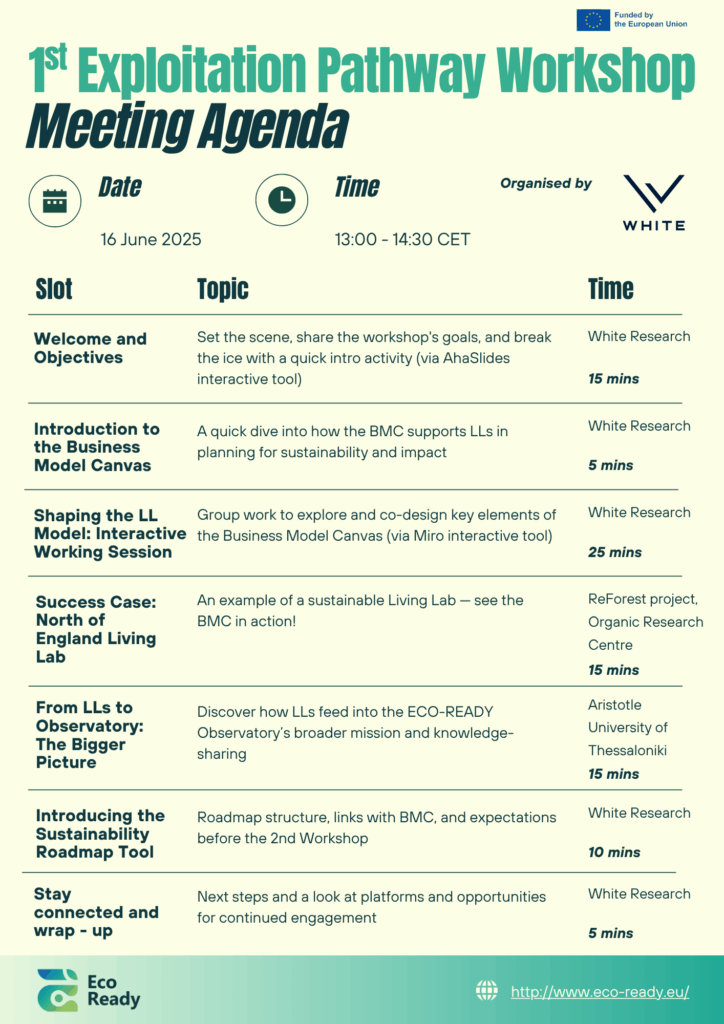 White Research facilitated the following key components:
- Welcome and objectives: Setting the tone and engaging participants through an interactive AhaSlides exercise on perceptions of sustainability.
- Introduction to the Business Model Canvas (BMC): A short briefing on how the BMC can support long-term planning.
- Interactive Working Session: A hands-on co-creation session using Miro boards to explore key BMC elements: value propositions, stakeholder ecosystems, funding strategies, and potential for scale-up.
- Sustainability Roadmap Tool: Presentation of a structured template to support each LL in developing tailored sustainability plans for the post-project period.
Key Highlights
The session guided LLs through defining their future strategies using the BMC and a Sustainability Roadmap template. Participants discussed core elements essential for their continuity: value propositions, stakeholder ecosystems, and funding strategies.
Challenges to sustainability: Participants identified funding security, stakeholder engagement, governance continuity, and maintaining visibility as major barriers. Addressing these issues is critical for LLs to move beyond short-term project cycles.
Future vision: Many Labs envision evolving into regional innovation hubs supporting policy, local capacity-building, and climate adaptation, ultimately contributing to more resilient and community-driven food systems.
Knowledge sharing practices: LLs currently rely on a mix of newsletters, public events, informal networks, and social media, highlighting the need for more structured and visible sharing mechanisms to strengthen their impact and connectivity.
Thematic Insights
- Value Propositions: LLs outlined diverse contributions tailored to local resilience needs, from drought management (Italy, Greece) and water conservation to innovation facilitation (Spain) and citizen science tools (Poland). Common co-benefits included ecological sustainability, economic stability for farmers, and community empowerment.
- Stakeholder Ecosystems: Farmers remain at the core, complemented by policymakers, public agencies, research institutions, and local communities. Successful engagement with these groups is central to institutionalising LL activities and ensuring policy alignment.
- Funding and Support: Most LLs are grant-dependent but are exploring diversification, including service-based revenues (e.g., consulting, policy tools), commercialization opportunities, and formal partnerships with ministries and regional bodies to secure long-term support.
Learning from Experience
In addition to the practical sessions led by White, the workshop featured a presentation of the REFOREST Living Lab in northern England, which demonstrated how long-term sustainability can be achieved through multi-stakeholder partnerships, advisory services, and regional integration. The Aristotle University of Thessaloniki showcased how LLs can integrate into the ECO-READY Observatory, enhancing their visibility and policy relevance.
Outcomes and Next Steps
This first workshop laid the foundation for a process of iterative learning and planning. Participants began drafting their BMCs and shared reflections on sustainability enablers and barriers across diverse regional contexts – from drought management to climate-resilient food systems and inclusive governance.
White Research’s facilitation helped create a collaborative environment for cross-Lab exchange, allowing participants to identify common challenges and locally relevant solutions. These early drafts of the BMC will inform each Lab’s Sustainability Roadmap, which will be the focus of the second Exploitation Pathways Workshop in early 2026. That session will be dedicated to peer learning, roadmap refinement, and alignment with the long-term goals of the ECO-READY Observatory.
Until then, LLs will continue refining their strategies, using inputs shared via Miro boards and other knowledge-sharing platforms. The collective effort supports the ECO-READY project’s ambition to create a resilient and responsive European food system by embedding Living Labs into a long-term, collaborative knowledge ecosystem